
Profile
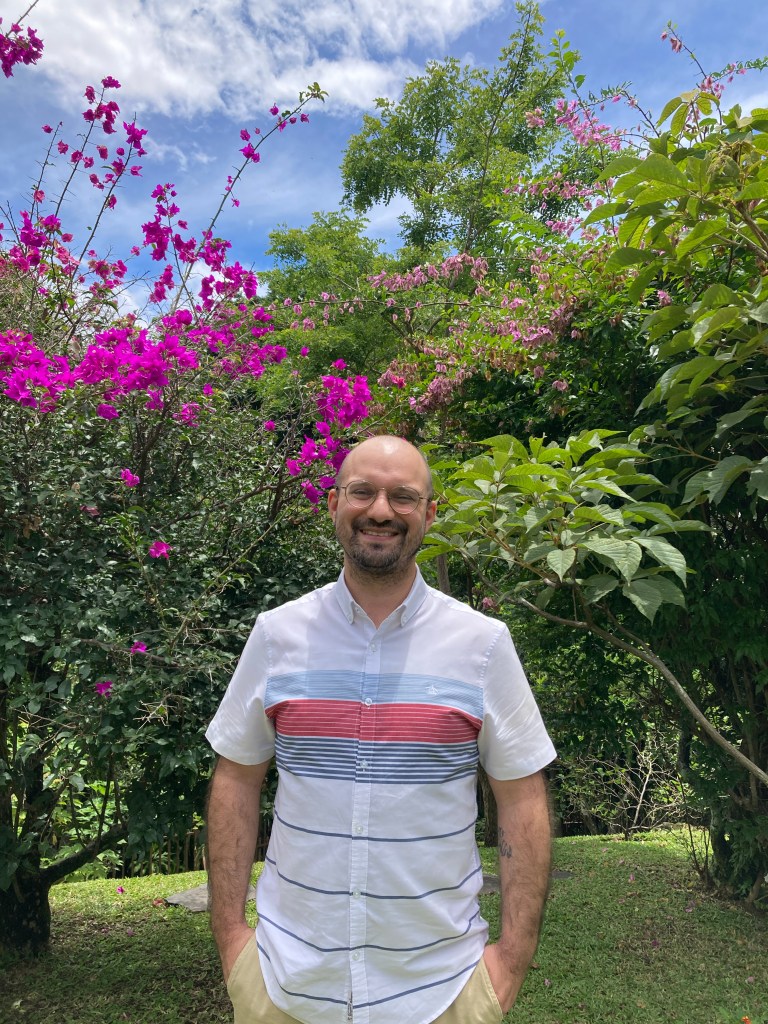
Hello there!
I am a physics lecturer at Universidad de Costa Rica and tutor at Einstein Prep and Learning.
My background is in theoretical physics and quantitative ecology, with a PhD in quantum information theory and postdoctoral research experience developing data science and machine learning workflows for environmental science. I am passionate about applying beautiful mathematical ideas to real world problem-solving, especially in the context of biodiversity conservation, environmental justice and natural resource management.
Quick CV
You can find my detailed CV here.
Lecturer in Physics, 2025-Present U Costa Rica
Lecture sizes of up to 50 students. Research on environmental data science, deep learning and quantitative ecology.
Tutor 2025-Present, Einstein Prep & Learning
Math, Physics, Programming & Circuit Analysis at several levels: IB, AP, SAT, ESAT, undergrad (e.g. calc, linear algebra). Programming and data science skills (python, deep learning, git, CI/CD, docker, etc).
Postdoctoral researcher, 2022-2025, UC Berkeley
Schmidt Center for Data Science & the Environment, and Carl Boettiger lab. Environmental data science, machine learning, environmental justice, statistical modeling.
PhD Physics (magna cum laude), 2022, U Cologne.
David Gross group, quantum computation and representation theory.
Teaching Assistant, 2018-2022, U Cologne.
Linear algebra, mechanics, quantum physics, mathematical methods.
MSc. Physics, 2017, U Cologne
David Gross research group, quantum computation.
Tutor, 2011-2015, Independent.
Tutoring math & physics at high-school and first-year undergrad levels.
My research summary
My work touches on tools from data science, machine learning and mathematical modeling, and particularly on using these tools for environmental protection and social justice. Broadly, I am interested in developing mathematical ideas and effective computational workflows that can aid the protection of biodiversity, the responsible management of natural resources and the healing of our relationship with our environments.
Being at the intersection of many different fields of knowledge, I have become adept at translating knowledge from one community to another in order to nurture interdisciplinary collaborations.
Here are some projects I am particularly excited about!
Environmental data science and indigenous data sovereignty
During my Postdoc at the Schmidt DSE, I had the privilege of closely collaborating with a team of indigenous biodiversity scientists to co-develop statistical, AI, and data science workflows to enhance their environmental restoration activities. This collaboration has grown into a research project spanning a wealth of ideas: species distribution modeling, animal movement modeling, computer vision, graphical user interface design, and community science. Check out our recent paper on elk population estimation using community-driven sighting data!
There’s two key aspects I’d like to highlight from this collaboration:
- Co-development of the research project has been at the heart of our work. Through frequent online meetings as well as regular in-person ones, we have been able to center the priorities and values of our indigenous colleagues in the management of their ancestral territory. This is a way of working that I deeply believe in: one that places enthusiastic consent at the very core of a project, and which weaves in our collaborator’s deep traditional knowledge of their lands into the fabric of the research project at all stages—ideating, planning, investigating and executing.
- We have dedicated time and resources to ensuring that our technical work upholds our collaborator’s rights (as well as their tribe’s rights) to indigenous data sovereignty. This has required critically evaluating software and data design choices, and understanding how our collaborator’s needs from the project relate to the CARE principles of data sovereignty.
Reinforcement Learning in Environmental Management
For the past 3 years I have been developing and applying deep reinforcement learning (RL) methodologies for adaptive management in several collaborations with ecologists and fishery scientists. Adaptively managing complex ecosystems (e.g. in the context of fishery management or habitat restoration) is known to be challenging, with decisions being taken under high uncertainty. This project shows that RL provides a framework to support data-informed decision-making which can outperform state of the art alternative management approaches.
Our initial paper on the subject uses a toy ecosystem model to explore tradeoffs between complexity and performance in quantitative policies. There we show that complex RL-derived policies which base decision-making on multiple observations generally outperform standard stock-biomass-responsive policies. This result, while interesting, was a proof of principle not immediately applicable to any real system. In a follow-up collaboration with Carl Walters and Chris Cahill, we went beyond this initial foray by developing RL based policies specifically geared towards Walleye fishery management in Alberta, Canada. Walleye stocks have been historically difficult to effectively manage due to their highly variable, spasmodic, recruitment patterns. We show that under certain circumstances, observations of the stock’s size structure can improve decision-making. Check out our open-source code! (Currently it is python-based—R-based code coming soon!)
Currently I am involved in a collaboration with Abby Keller and Jim Jiang developing RL methodologies for the adaptive management of invasive green crabs in Northwestern USA. We’ve been getting some promising results in which RL agents can use memory to detect observation patterns over time and thus optimize patterns for crab trapping efforts. You can find our progress in this repository.
As happens with all open-ended research lines, I have also explored a bunch of other interesting avenues as well. One that I feel might be particularly promising in the future is a project where I explore Curriculum RL in cases where environmental decisions under significant model uncertainty—a feature that is almost universal in ecosystem management.
Thinking meta: the use of AI in environmental decision-making
The use of AI tools in ecology and environmental decision-making is rapidly increasing, with numerous technical advances in computer vision, audio recognition and species distribution modeling, as well as novel improved standards for sharing large data-sets in the field accelerating this growth. It is crucial that we harness the power of these new tools effectively and responsibly. I am part of two exciting collaborations which are critically examining this.
A first collaboration spawned out of the workshop EcoViz+AI: Vizualization and AI for Ecology. This collaboration explores how to foster a community of practice for AI methodologies in Ecology. The nascent field of environmental data science lives at an intersection: between quantitative ecology, computer science, indigenous data governance, and conservation biology. It is key that, as this field grows, we develop practices and infrastructure that enables knowledge transfers, and which democratizes the accessibility of complex and often computationally intensive methodologies. In this collaboration we studied how this can be achieved through 5 technical case studies—projects among our collaborators that brought together techniques from AI (broadly defined) as well as knowledge from a variety of fields like wildlife ecology, oceanography, data visualization, and neurobiology. We refined and restructured the software associated to these projects to facilitate their reproducibility and extensibility.
In this recent preprint, we summarize the lessons that we have learned in this process, and how these may help to foster an Ecological AI community: a community in which ecologists can make informed decisions about when to use an AI model, which model is a best fit, how to implement such a model, and how to invite others to extend and contribute to the model.
A second collaboration got kickstarted through a wonderful conversation with Diego Ellis Soto and a number of colleagues at a SeekCommons workshop in 2024. In this collaboration we critically examine conservation prioritization decisions through AI-powered species distribution models.
Other projects I’ve dabbled in…
I have dipped my toes on ecological time-series forecasting as well, having worked on using Python Darts models to predict variables of ecological interest in the NEON forecasting challenge. You can see some experiments I have performed in this repository!
Lastly, I want to plug a project with which I interacted only very briefly, but which was a wonderful learning experience both on technical aspects as well as in important social aspects to environmental justice: Examining environmental justice through open source, cloud-native, geospatial tools.
My research soapbox
I am a physicist by training. My entire education history is physics-centred, and I have been passionate about different topics over time: experimental solid state as an undergrad, theoretical condensed matter and quantum information as a masters student, and finally converging on representation theory and quantum computing as a PhD student. The question which might come up at this point is: and how did you come to work at an environmental science, policy and management department?
This was a conscious decision to switch my research focus towards topics which I feel are of utmost importance nowadays. My decision was inspired by the COVID pandemic and Black Lives Matter movement in 2020—it made me reflect on the many sources of social injustice, on the harm they cause and my positionality in them. It made me ask myself the question how do I use my quantitative skills to make a positive impact in the world? How can I use my skills as a source of healing in a world which is caught at an intersection of racism, colonialism, gender violence, and climate change?
The answer for these questions led me to my current research interests—a symbiotic relationship between data science, ecology, and indigenous emancipation.
More
Check my GitHub profile for up-to-date code on these and other projects!
My PhD research
Throughout grad school I worked at the interface of representation theory and quantum computing. My work spanned abstract algebra, numerical linear algebra, algorithm development and coding. I made contributions characterizing Clifford tensor-power representations, approximate unitary t-designs, measures of quantum non-stabilizerness, and developing algorithms for numerical representation theory. Importantly, my work helped establish a link between the mathematical literature on the Theta correspondence (also known as Howe duality), and the physics literature about the representations of the Clifford group.
Outreach
I was an active member of the science communication collective ManyBodyPhysics. There I produced a cute little article on randomized benchmarking for quantum computers which I am very proud of.
Contact
Don’t hesitate to reach out to me at felimomo [at] berkeley.edu
Media: LinkedIn, GitHub, Google Scholar, ManyBodyPhysics
My office is Wellman 210, at the UC Berkeley campus.
Get new content delivered directly to your inbox.
 Felipe Montealegre-Mora, PhD